☁️ The Right to Dream for Every Human Being: How DreamStarter Helps the Underserved Escape Social Traps
 Arun Philips
Why and for whom are we building DreamStarter? Humans are happiest realizing our dreams, yet modern life and structures make us cogs in others' machines. We believe every person has the right to dream. DreamStarter's automated AI Agents ensures dreams become reality—no matter what social structures the dreamer is trapped in.
Why do we dream? We dream so we can make sense of this world we live in. We dream so we can innovate, solve complex problems and express our love and care for each other and ourselves.
Dreams matter because they're how humans generate their own direction instead of just absorbing someone else's. A dream is a self-authored goal: it says this is what's worth my time, that act of authorship is most of where meaning comes from. People with a strong sense of purpose live longer, report far less anxiety and depression, and rate their lives as more worthwhile.
A dream is the one thing the structures can't hand you. Food, shelter, even a job can be provided — but a dream has to come from inside the person, which is what makes the "right to dream" a right rather than a resource. The injustice isn't that people lack dreams; it's that they have them and have no way to act on them.
Dreams Trapped in Social Structures
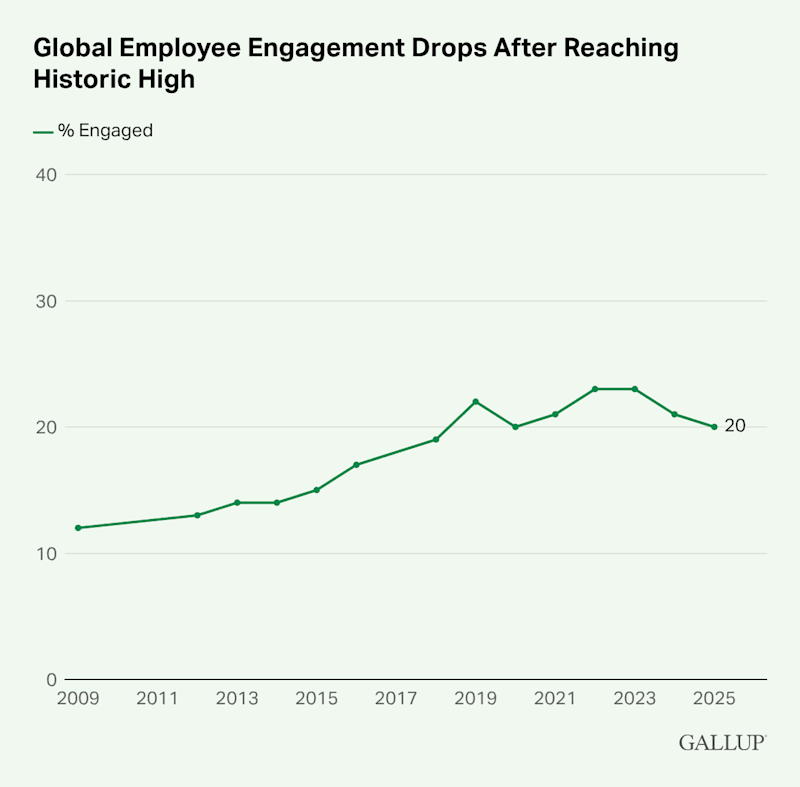
Gallup's most recent global workplace data finds only 21% of employees are engaged — meaning roughly 8 in 10 are not. Specifically, 62% are "not engaged" (going through the motions) and another 15% are "actively disengaged." Engagement actually fell in 2024, only the second drop in 12 years, and the disengagement costs the world economy an estimated $438 billion a year in lost productivity.
OECD's A Broken Social Elevator? finds it takes four to five generations on average for a child born into the poorest 10% to reach their country's median income, and up to nine generations in the least mobile countries. The OECD frames this as "sticky floors" trapping people at the bottom and "sticky ceilings" hoarding opportunity at the top. In other words, where you're born, not what you dream, largely dictates where you end up.

stuck in mobility
On the absolute scale of structural deprivation: about 838 million people live in extreme poverty (World Bank, 2024, under the updated $3/day line). Sub-Saharan Africa is 16% of world population but 67% of the extreme poor.
Humans are Happiest Realizing their Dreams
Eudaimonic wellbeing: the sense that what you do is worthwhile and purposeful is linked to living longer: a UCL study found people with low sense of purpose had roughly 2.4x the mortality risk of those with high purpose, even after controlling for health and demographics.
Survey data on regret reinforces the emotional core: among people whose job doesn't match their childhood aspirations, 72% regret it and 67% still dream about those early ambitions, with more than half saying they'd trade their current career for the dream one.
Realizing Dreams Inspite of The Structures We Are Trapped In
The structures trap people not by forbidding dreams but by gatekeeping the resources a dream needs: capital, expertise, networks, time. AI attacks each of those gates directly.
It collapses the cost of starting. The old machine demanded money and a team before you could even test an idea. A full solo-operator AI stack now runs roughly $75–$150/month. That's why solo-founded startups jumped from 23.7% of new startups in 2019 to 36.3% by mid-2025. The barrier that said "you need backers to begin" is quietly dissolving.
It democratizes expertise. A dream usually dies not from lack of will but lack of know-how: you don't know how to register a business, write the code, design the brand, read the contract, or reach a customer. Those used to be expensive professionals guarding the gate. AI hands that expertise to anyone who can ask — the same tutoring, legal-literacy, and technical guidance a wealthy person buys, available to someone in an underserved region with a phone.
It gives back time and agency. Disengaged workers are cogs partly because their hours are fully consumed by someone else's machine. AI automation reportedly returns 15–25 hours a week to solo operators by handling the drudgery. Time is the raw material of any dream; automation is how a trapped person finds enough of it to build a second life alongside the first.
Where DreamStarter fits in
Tools lower barriers, but they still require the dreamer to be the operator: to know what to ask, to stitch ten apps together, to project-manage themselves. That's a real residual barrier; and it's exactly the one that still favors the already-educated and already-connected. DreamStarter's promise is to close that last gap by making the execution itself automated.
Instead of handing someone a toolbox and wishing them luck, autonomous agents carry the dream from intention to reality; doing the steps, not just advising on them. The dreamer supplies the vision; the agents supply everything the structure withheld.
The right to dream is empty without the means to act, and historically the means were rationed by birth, wealth, and geography. AI is the first technology that can ration them by imagination instead.
An honest caveat: the digital divide is real and in places like Africa, the open question isn't whether AI exists but whether it reaches underserved communities affordably and reliably.
At DreamStarter we aim to take this divide head-on by designing for the trapped, not the connected. Rather than assuming a powerful device, fast broadband, and digital fluency, our agents run in the cloud, reachable from a basic phone, a shared connection, or a simple text exchange in native languages.
Because agents do execution autonomously, the dreamer doesn't need technical skill, English fluency, or the time to operate a stack of tools: they only need to express what they want, in their own words and language. We're working with NGOs and social impact organizations around the world to ensure 100% free access to our tools to those who need it the most.
The mission isn't just to put AI in the world; it's to deliver it the last mile into the hands of the people the old structures were built to keep out.
.......
About DreamStarter: DreamStarter turns your dreams into reality — automatically handling everything from content creation and lead discovery to email outreach, while you focus on dreaming bigger. From brainstorm to launch in 24 hours, with zero team and next to zero effort.
Contact: hello@dreamstarter.xyz | www.dreamstarter.xyz