The NGO Guide to DreamStarter: how impact organisations run marketing, outreach and fundraising on AI agents ✨
 Arun Philips
Every NGO we have met has the same two problems. The work is real and the people are extraordinary, but nobody has time to tell the story, and nobody has time to chase the money. The founder is the fundraiser, the social media manager, the grant writer and the person on the ground, all at once.
DreamStarter was built for exactly that person. You describe your mission once, in plain words, and a team of AI agents starts doing the marketing and outreach work around it: researching your audience, writing and publishing posts, cutting clips from the videos you already have, finding the people most likely to care, and reaching out to them under your own name, with your approval on every send.
Your first dream is free, with full access. This guide walks through what the agents actually do, how to set up your dream in an afternoon, and what real impact organisations on the platform have got out of it so far.
🧭 What a "dream" is, and why one NGO = one dream
On DreamStarter a dream is a workspace for one mission. Everything inside it is scoped to that mission: the brand, the knowledge base, the social accounts, the contacts, the outreach. If you run one organisation, you run one dream. If you run an umbrella body with three programmes that each need their own voice, you can run three.
Inside a dream there are four moving parts:
The Dream Brief. An eight-field summary the agents work from: working title, summary, purpose, audience, identity, progress so far, next step, and open questions. This is the source of truth for everything the agents write.
The Dream Board. A kanban of feature cards, organised into five phases: Foundation, Build, Launch, Growth, Scale. Each card is one piece of work the agents can take on (a brand kit, a weekly content plan, a lead list, an outreach sequence).
The agents. Around 16 specialised AI agents: Social Media Manager, Research Analyst, Brand Designer, Content Strategist, Email Marketer, Growth Analyst, Partnerships Lead, Fundraising Advisor and more. They execute the cards and coordinate with each other.
The knowledge base. Everything the agents produce and learn goes back into the dream, so the tenth post sounds like your organisation, not like a generic AI.
Every card runs in one of three modes, and this matters a lot for NGOs: Autopilot (fully autonomous, good for content), Co-pilot (the agent pauses for you to approve or revise before anything goes out), and Approval-gated (nothing moves without your explicit sign-off, which is the default for outreach, anything legal and anything financial). No cold email ever leaves your dream without a human clicking approve.
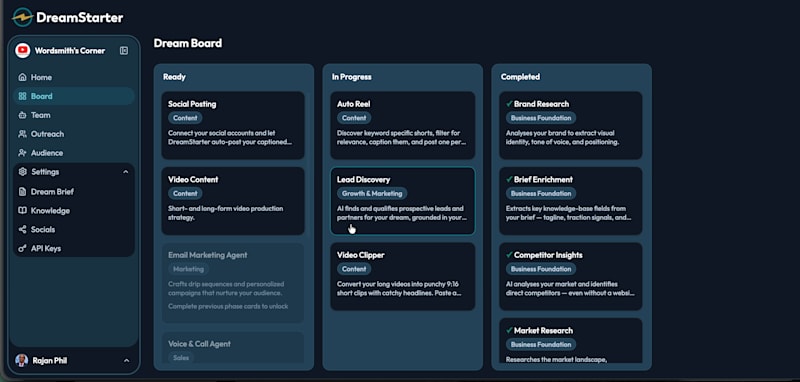
A Dream Board: every card is one piece of work an agent can take on, moving from Ready to In Progress to Completed.
🛠️ The workflows that matter most for impact organisations
There is a lot in the platform. These are the six workflows NGOs actually use.
1. Autonomous social publishing, and post once to publish everywhere
Connect your accounts (X, LinkedIn personal and page, Instagram feed, reels and stories, YouTube, TikTok, Farcaster) and the Social Media Manager starts filling a content calendar. If your team already lives on Instagram, keep doing what you do: post there, and the agents automatically cross-post to every other connected platform, reformatted for each one (a LinkedIn post reads differently from a tweet, and the agents handle that). One habit, five channels.
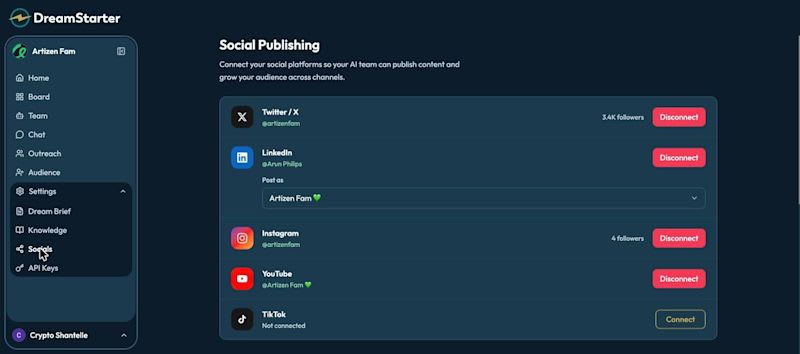
Connect the platforms once; the agents publish to all of them.
Posts are generated per platform from your brief and knowledge base, images can be generated on demand, long posts are split into threads automatically, and failed posts are retried and flagged rather than silently dropped. You can drag posts around the calendar, edit anything, or leave it entirely on Autopilot.
For an NGO this is the difference between posting when someone remembers and posting every day.
2. Video Clipper and Auto Reel
Most NGOs are sitting on hours of footage: field visits, event recordings, talks, beneficiary interviews. The Video Clipper watches a YouTube channel or takes an upload, cuts the strongest moments into short clips with headlines and word-level captions, and posts them across your platforms on a schedule. Auto Reel does the same for a single short video: drop it in, get a captioned reel out. Across the platform the agents have generated 434 clips so far, and the highest-performing dreams are the ones that feed the clipper every week.
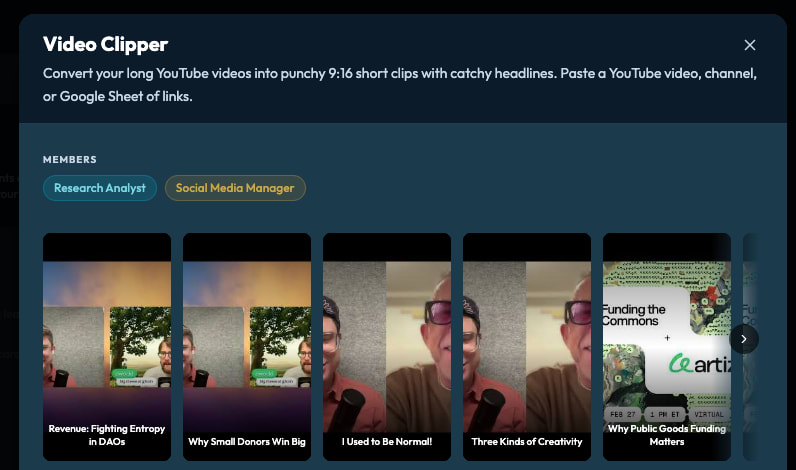
The Video Clipper turns one long recording into a row of captioned 9:16 clips, each with its own headline.
3. Carousels and story content
The content planner has a carousel mode that turns a report, a programme update or a set of stories into a multi-slide post for LinkedIn and Instagram (with an automatic four-slide cut for X). Impact reports, "meet the team" series and donor thank-yous all work well here.
4. Lead finding and a CRM built for relationships
The Research Analyst and Partnerships Lead build lists of the people your mission needs: CSR heads, foundation programme officers, journalists on your beat, local businesses, potential volunteers. Every contact lands in a dream-scoped CRM with tags, fit scoring (with a written rationale), lead temperature, and opportunities that can be typed as grant, partnership, sale or investment with a value attached. There is also a connections graph that finds intro paths, and a "Today" worklist so you always know who to follow up with.
Across all dreams the agents have surfaced 11,372 leads so far. The point is not the number. The point is that a two-person NGO now has a pipeline.
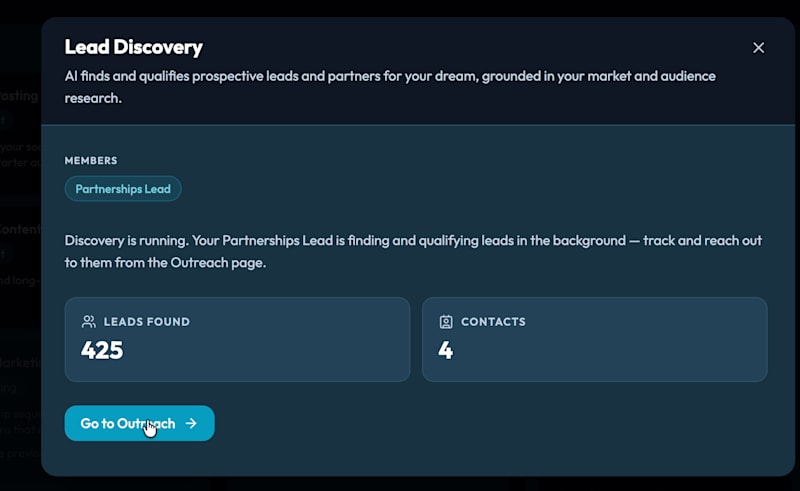
Lead Discovery runs in the background; you pick who to reach out to from the Outreach page.
5. Outreach sequences from your own mailbox
This is the workflow that raises money. You connect the mailbox you already use (Gmail, or any SMTP account like Zoho or your domain host), and the Email Marketer writes multi-step sequences: a first email, a wait, a follow-up if there is no reply, a different branch if there is. Merge tokens personalise every message, replies are detected and routed to you, and every send is approval-gated. Emails go out from your address, in your name, so a programme officer sees a note from the founder, not from a tool. The agents have sent 1,362 sequence emails on behalf of dreams to date, all of them approved by a human first.
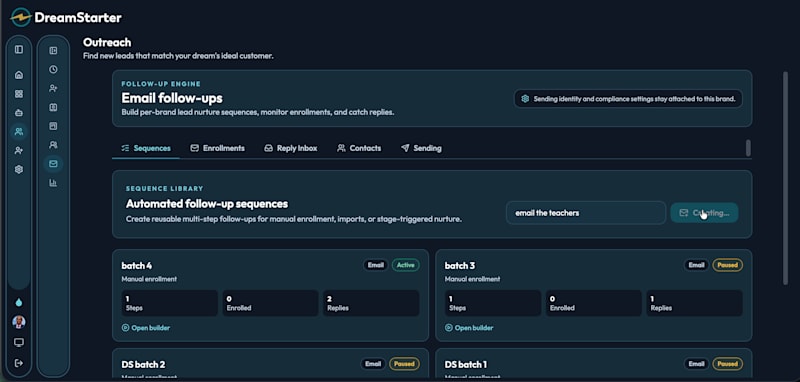
Sequences, enrollments, reply inbox and sending identity all live in the Outreach tab.
The Pitch Block sits underneath this: a reusable set of outreach copy (what you do, who it is for, your one-liner, your traction) distilled from your brief, which the agents reuse in every sequence so your story stays consistent.
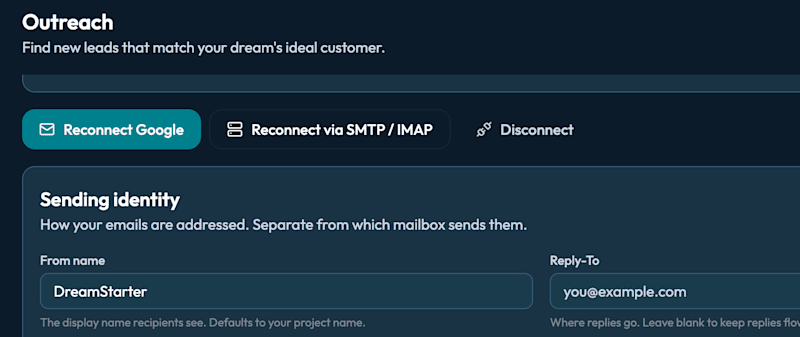
Every dream sends from a mailbox you connect, under your own name.
6. Fundraising support and believer pages
The Fundraising Advisor agent helps you shape a funding ask, map the funders and community funding routes that fit your category, and draft the applications. We run our own fundraising on the platform too, so the agents' knowledge base includes what a live, working raise actually looks like.
One honest note: we only actively support a raise, with hands-on help and introductions to our community, for projects we have reviewed. That review is light (a call, proof the work exists, a clear answer on where the money goes), and every project we name in this guide has been through it.
We are also rolling out believer pages: a public page for every dream where supporters can back it, with a live counter and a referral loop. Every believer becomes a contact in your CRM, so your supporters and your outreach live in one place.
✨ Setting up your dream (about an afternoon)
Here is the honest setup sequence, in the order that works.
Step 1: Talk to the Dream Guide. Create a dream and the Dream Guide interviews you, one question at a time, with quick-reply chips. It does its own web research on your organisation as you talk. Answer plainly. The better you describe your audience and what "progress so far" looks like, the better every downstream output is. At the end you have your Dream Brief. Read it and fix anything that is wrong. This is the ten minutes that matters most.
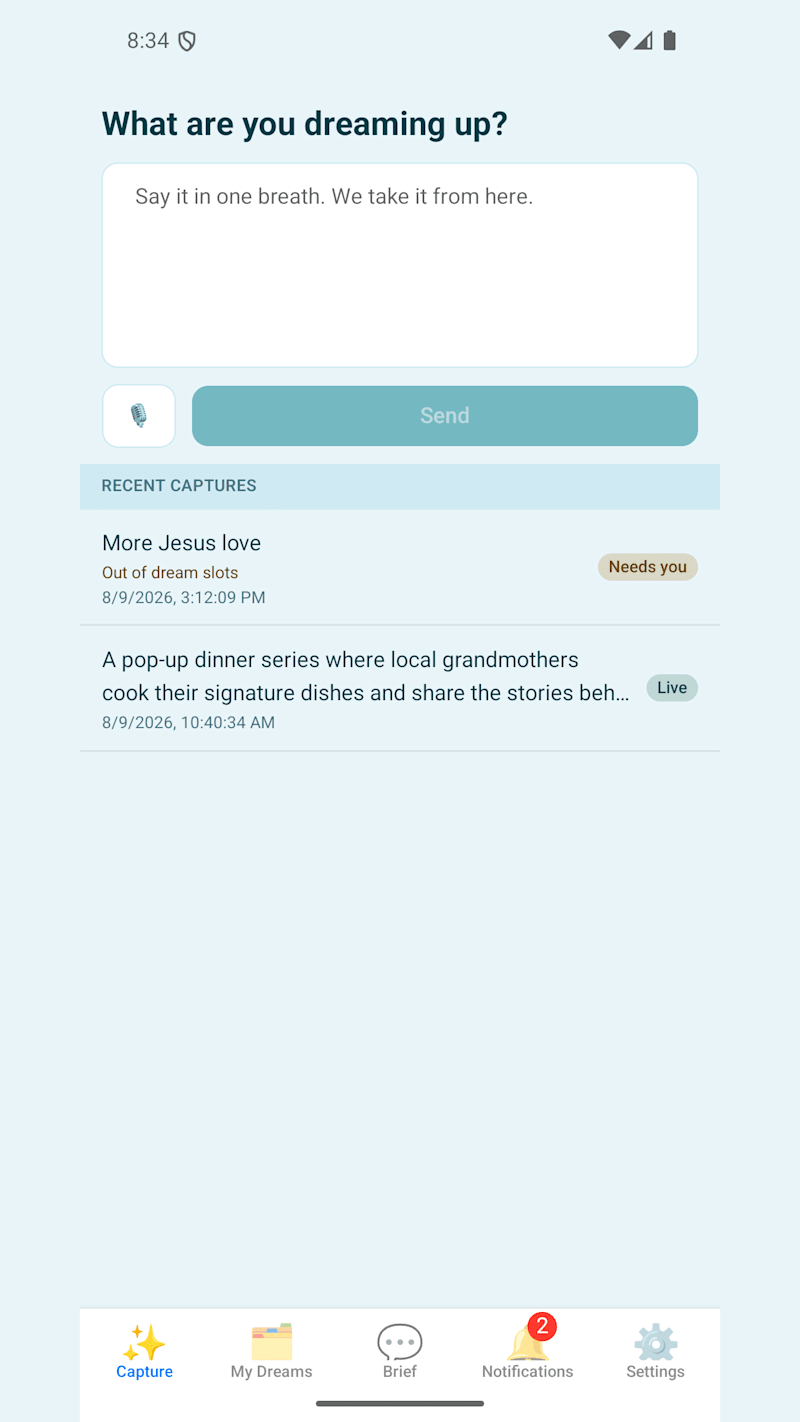
The Dream Guide on mobile: describe the mission in one breath, by voice if you like.
Step 2: Let the Dream Analyzer build your board. The analyzer classifies your dream (most NGOs land in "social impact", some in "education" or "community") and picks the right cards from the 40-card catalog into the five phases. You can add or remove cards.
Step 3: Load the knowledge base. Upload your annual report, your last three grant applications, your brand guide if you have one, your best photos and any existing video. The agents read all of it. This is what stops the content sounding generic.
Step 4: Connect one platform and one mailbox. Do not connect everything on day one. Connect the platform where your supporters already are (for most Indian NGOs that is Instagram or LinkedIn) and the founder's Gmail. Add the rest once you trust the output.
Step 5: Run the brand card in Co-pilot. Let the Brand Designer and Content Strategist propose a voice, a visual direction and a first month of content themes. Approve, revise or reject. This sets the tone for everything after.
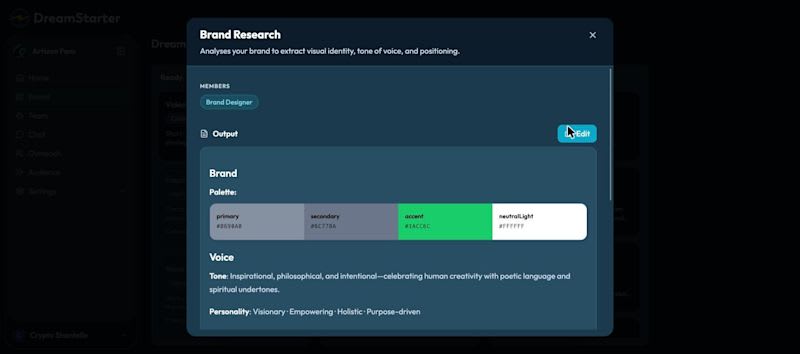
The Brand Designer proposes a palette and a voice from your brief; you approve it once and every agent uses it.
Step 6: Turn on publishing, feed the clipper, and start one sequence. Put social publishing on Autopilot with a weekly review. Point the Video Clipper at your YouTube channel or upload a batch of field footage. Then build one outreach sequence to one audience (say, 30 CSR heads in your city), approve the first three emails personally, and watch what comes back.
Step 7: Review weekly, not daily. The dreams that work best are reviewed in one sitting a week: approve the queue, read the replies, adjust the brief. That is the whole job.
🌱 Impact organisations already running on DreamStarter
These are real dreams with real numbers, pulled from the platform in late August 2026.
Decentralised AI and Web3 for Rural Farmers is a social-impact project telling the story of technology in rural agriculture. Its dream has published 44 posts across platforms and built a list of 92 leads, all from a brief and a founder who reviews once a week. The angle that worked: consistent storytelling first, outreach second.
Abu Dhabi Changemakers Spotlight is a community series celebrating people doing good in the UAE. Its agents have published 34 posts, built 59 leads, and the Video Clipper turned each spotlight interview into clips posted per platform. One person, a spotlight format, and a media operation running behind it.
Artizen Fam is a fan-run hub celebrating an impact-funding community's creators, and one of the busiest dreams on the platform: 79 posts across four platforms, 13 daily project-highlight carousels in its first six days, weekly auto-clipped interviews, and 92 creators in its CRM. We wrote the full workflow story here: Workflow Stories #2: Artizen Fam.
Mission Dignity for Every School is the one we are proudest of. Anitha Nandigam, who works on government education reform and presented at Dream House Hyderabad, is raising money to build safe classrooms and functional toilets in underprivileged schools. She runs her storytelling and outreach on DreamStarter, and so far she has raised around $500 through these workflows. Small, real, and the first proof that a founder with no marketing team can start funding a mission this way. If you want to support her work, message us and we will connect you.
Alongside these, around ten NGO and impact partners from Dream House Hyderabad run free dreams on the platform today.
📊 What the whole platform has done so far
As of early September 2026, across all dreams: 521 posts published on five platforms, 434 video clips generated, 11,372 leads discovered, and 1,362 personalised outreach emails sent, every one of them approval-gated. Dream House Hyderabad brought together 150 people including 50 NGO founders and CSR leaders, and we built live agent workflows for selected social projects on the spot.
💬 A note on safeguards
Impact work touches vulnerable people, and marketing it badly does harm. Three things to set in the brief on day one:
Write your consent and dignity rules into the knowledge base (no beneficiary faces without consent, no poverty framing, names changed for minors). The agents will follow them.
Keep outreach Approval-gated. It is the default. Leave it there.
If your organisation works in crisis support or health, add the referral lines and safe-messaging standards you follow, so no post ever implies a service exists before it does.
✨ Start your dream
Your first dream is free, with full access to every workflow above. Set it up, run it for a month, and tell us what happened: we publish the stories of the organisations building on DreamStarter as our Workflow Stories series.
If you are an NGO founder, a CSR lead, or a funder who wants to bring a cohort of impact organisations onto the platform together, message us on any of our channels and we will set the cohort up with you.