Is Capitalism's version of Decentralization working?
 Arun Philips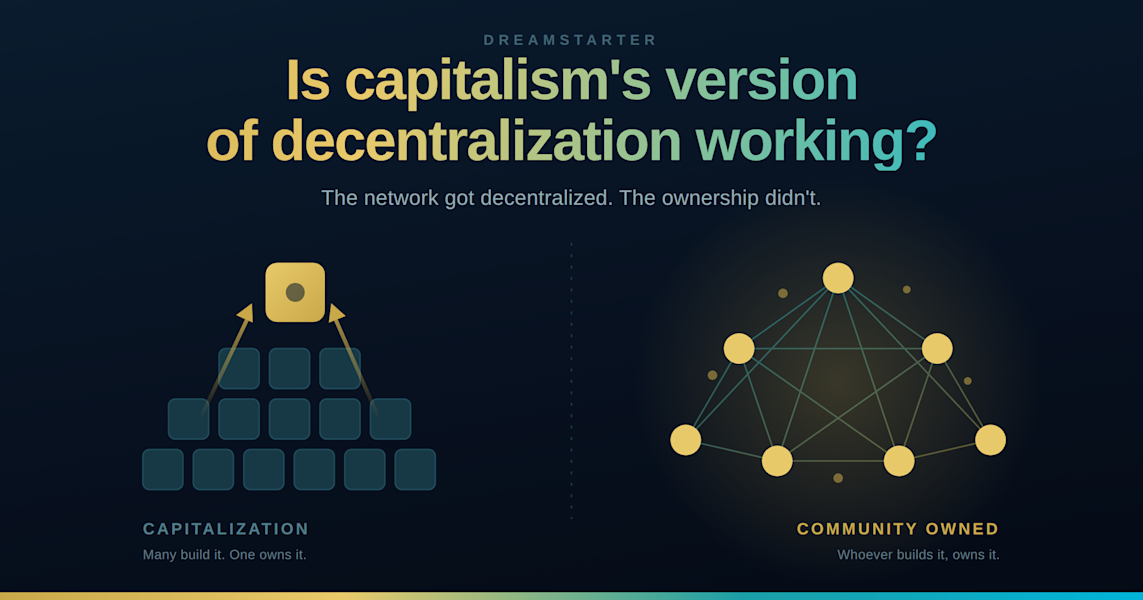
Uber, DoorDash and Zomato already decentralized their networks. They just kept the ownership. What's broken, why tokens didn't fix it, and what we want to try at Devcon. ⚡
Decentralization isn't novel. We just don't usually call it by that name.
Uber, DoorDash, Zomato: these are all decentralized networks. None of them own the cars, the kitchens, or the couriers. What they own is the coordination layer: the app that matches a rider to a driver, a hungry person to a restaurant. The supply is already out there in the world, independent and distributed. The platform just organizes it.
So in a real sense the gig economy already delivered on the promise of decentralization. Take a service that used to require one big centralized operator, a taxi fleet or a restaurant chain, and spread it across thousands of independent participants.
But their version of decentralization is flawed. Look closely and it isn't really decentralization at all. It's capitalization.
💸 The cold-start problem
Here's why. Every decentralized idea needs a network, and networks are brutally hard to start. This is the classic cold-start problem. An app with no drivers is useless to riders; an app with no riders is useless to drivers. Someone has to pay to drag both sides onto the platform at the same time and keep them there until the thing becomes valuable on its own.
Capitalism's answer to that problem is capital. VCs and investors plow billions into a network to grow it fast and lock everyone in. Uber raised more than $24 billion across equity and debt before it ever turned an annual operating profit, and SoftBank led a roughly $9 billion deal on its own in 2017. A huge share of that money went straight into subsidizing rides and paying driver bonuses to buy scale. The strategy even has a name: blitzscaling. Prioritize speed over efficiency, corner the market, become the default before anyone else can.
🪤 The extraction phase
And once the network is mature, once the riders can't easily leave and the drivers have nowhere better to go, the capital gets extracted back out. Subsidies dry up. Prices rise. Commissions creep up. The take rate climbs. DoorDash charges restaurants 15%, 25% or 30% of every delivery order depending on the tier, before marketing fees push it higher still. That's the extraction phase, and it isn't a bug. It's the whole point of the model.
It worked out fine for consumers inside the network. We got cheap rides and cheap delivery, at least for a while. But the operators, the drivers, the couriers, the restaurants, pay the price. They're the ones who actually built the supply, and they're the ones squeezed once the platform has the leverage. They did the work of decentralizing the service, and they own none of the thing they built.
🪙 Web3 and tokens were supposed to fix exactly this
The pitch was elegant: instead of paying VCs to bootstrap the network and then extracting from the participants, you issue a token and hand ownership to the people who show up early, the users, the operators, the ones doing the work. The network bootstraps itself, because the people building it own a piece of it. a16z literally branded this the web3 playbook: use token incentives to solve the bootstrapping problem so the value accrues to participants instead of investors.
And it worked, for one specific use case. Money. 🟠 Bitcoin actually decentralized money. There's no company, no VC on the cap table, no founder who can quietly hike the take rate. The network runs and the value belongs to the people holding and securing it. For that one idea, the model delivered on the promise.
But for almost every other idea, web3 decentralization collapsed straight back into the capitalization model it was built to escape. Same VCs, same playbook, just faster. Tokens launch with a tiny sliver of supply actually circulating and an enormous fully-diluted valuation. Insiders buy in early and cheap, retail buys the listing, and then the vesting unlocks arrive and the early money sells into the crowd. Retail becomes the exit liquidity, the modern version of Uber's drivers, except now the extraction takes months instead of years. The technology changed. The incentive structure didn't. Founder greed and investor greed pulled the whole thing right back to the same place.
So the uncomfortable question is the one in the title. Capitalism's version of decentralization, VC-funded and extract-at-maturity, is the version that actually got built, twice now. And it isn't obvious it's working, unless you happen to be the one holding the capital.
Which leaves the questions I actually want to sit with.
❓ Open questions, for US to answer
1. What is the different model of decentralization? If it isn't "VCs fund the network and extract at maturity," then what is the alternative structure that still solves the cold-start problem? Something has to pay to get both sides of the network onto the platform. If not concentrated capital, then what?
2. How can it actually be different from capitalization? Web3 tried and slid right back. So what would stop a new model from sliding back into the same extract-at-maturity pattern? Is the answer about ownership, about governance, about who's even allowed on the cap table, or about removing the point of extraction entirely?
3. What can we learn from how money was decentralized by crypto? Bitcoin is the one clean success. What was special about money as a use case, no company, no equity, no operator to capture the network, and which of those properties could realistically carry over to other ideas? Which ideas share money's shape, and which never can?
🔥 We're taking these questions to Devcon
One thing has changed since the last two attempts, and it's why we think this is worth reopening now: the cost of building an idea is going to zero. If building no longer needs millions of dollars, the money isn't buying the product any more. It's only buying distribution. Which is exactly what tokens are supposed to be good at, when they aren't being used as a fundraise.
So we're proposing a workshop at Devcon: Decentralize Everything: build, launch and market a community-owned company in 60 minutes. AI agents do the building and the marketing, and then we launch a 100% fair community token with no insider allocation waiting to sell into the crowd. An attempt at the three questions rather than a talk about them. 🌱
Participants get shortlisted by sharing their idea for a decentralized version of a centralized service, product or company that already exists. We've all seen the decentralized-Uber euphoria of the ICO phase, and we know it failed. It failed because of founder greed, not because the idea was wrong. 💡
Got one in your head? Start it at DreamStarter.xyz and bring it to the workshop. ⚡